


City and hockey. A connection that is crucial for every club. It is in the city and its wider surrounding area that the fan base is built — one that fills arenas and, at the same time, brings money into the club’s coffers. Note: For simplicity, throughout the text I will use the term “city”, although in some cases (for example, in Sweden’s SHL) this may formally refer to a municipality or another form of local government. I do not include regions, cantons or other regional levels in the comparison.
In addition to the fan base, cities have another crucial role. The overwhelming majority of ice hockey arenas in the nine highest-ranked European leagues according to the IIHF ranking are owned or co-owned by cities. I include the international ICEHL under Austria in this comparison, while Latvia is not included, as the country does not have a professional league. Hockey organizations pay various forms of rent for the use of arenas — from full market-rate rent to subsidized rent, and in some cases they can use the ice and other arena facilities completely free of charge. With subsidized rent, part of the costs is indirectly covered by the city, which also reduces the financial burden on the owners.
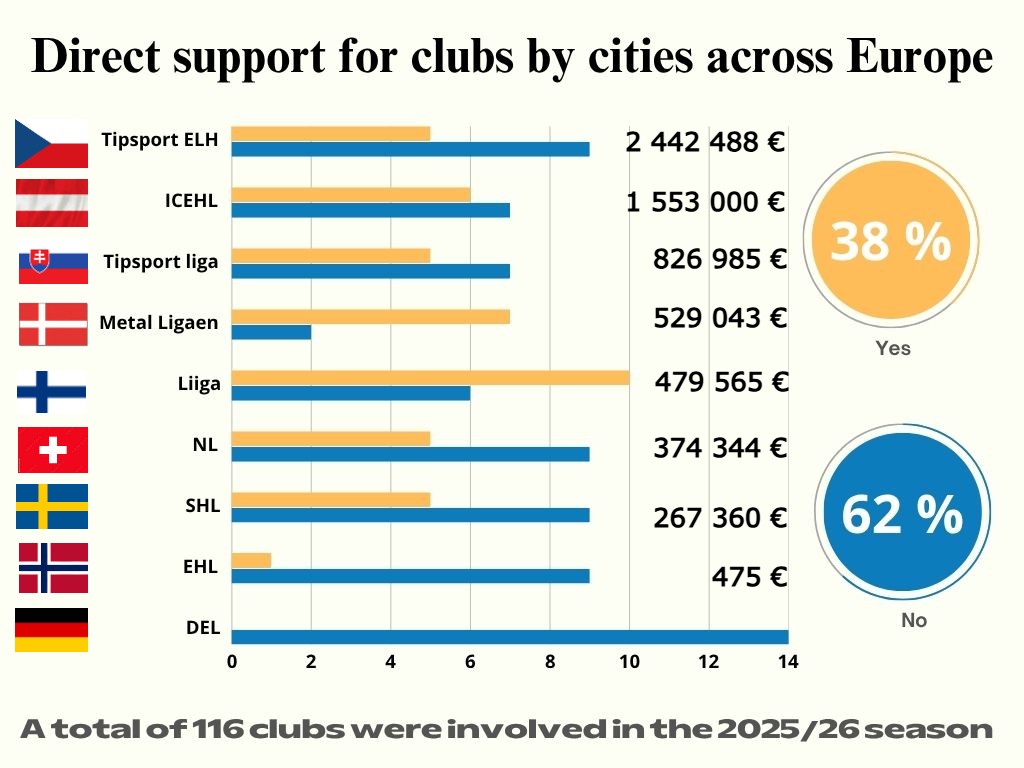
Among the 116 cities across the nine leagues, 44 provide organizations with direct financial contributions for sporting activities. Note: I consider direct financial contributions to include direct payments from the city, marketing partnerships between the city and the club, or contributions provided through a municipal foundation. I do not, however, include sponsorship agreements between clubs and companies that are 100% owned by the city. This model is particularly common in Sweden’s SHL. I also do not include subsidies covering the cost of ice or arena facilities. I mention these costs only for context, to provide a better picture of the overall level of public support received by individual clubs.
How much support do cities provide across Europe’s leagues?
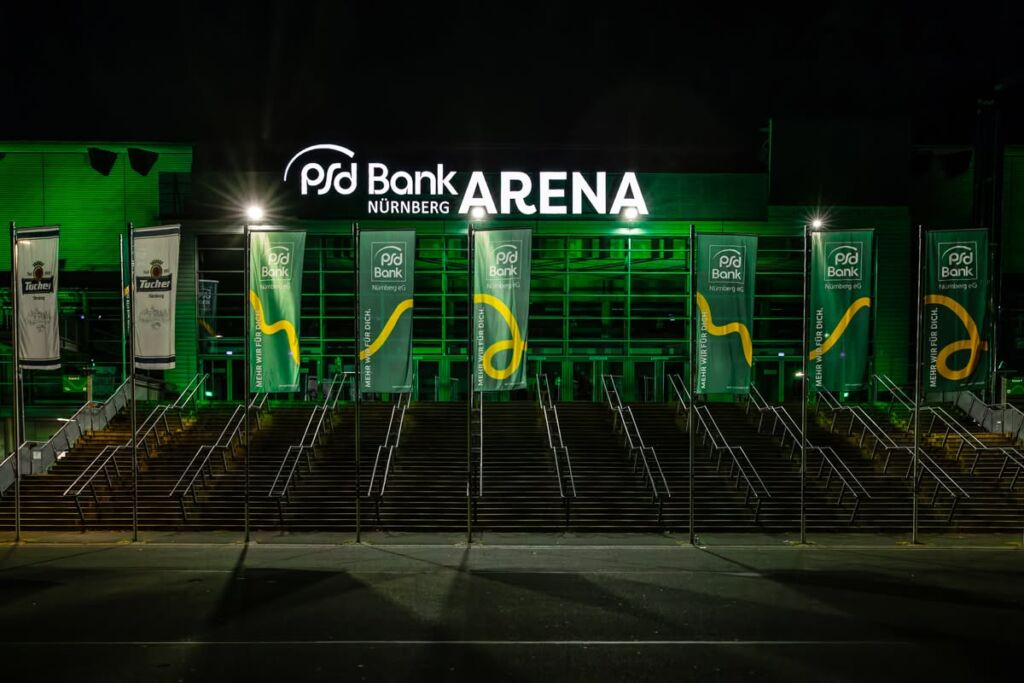
In Germany’s DEL, none of the 14 clubs receives direct financial support from its city. “I know that we are all going through very difficult times and that sport is not a priority. However, it would be good if the state and cities supported hockey more in Germany. Nürnberg Ice Tigers are the flagship of sport in a city of half a million people. No other club plays in the top division. It would be enormously helpful if the city provided us with financial support, because we pay more than €1 million per season to rent PSD Bank Nürnberg ARENA. In my opinion, the lack of support for DEL clubs is linked to hockey’s insufficient standing in the country. Hockey simply does not have the same status in Germany as it does in Sweden, Finland, Czechia, Slovakia or Switzerland,” says Stefan Ustorf, a former German international who is entering his seventh season as the Ice Tigers’ sporting manager.
In Finland’s top division, Liiga, 10 of the 16 clubs receive financial contributions. However, these are not huge sums and are mostly marketing contracts. Kiekko-Espoo receives the most, at €100,000 per year. “It is extremely difficult, if not virtually impossible, for a club to operate profitably. Kiekko-Espoo plays in a privately owned arena, and the distribution of revenue from home games is not fair to the organization. In the long term, it is very difficult for the organization to survive because it is suffering from a highly unfavorable arena agreement,” wrote Janne Aalto in 2025, then a director at the auditing firm EY (Ernst & Young). “In 2026, as a city, we decided to support training hours by covering 90 percent of the total cost. In this way, we will help the club with between €50,000 and €100,000 annually,” adds Martti Merra, Sports Director of the City of Espoo.
The clubs in Czechia’s top-flight Tipsport ELH receive the highest combined support from cities. In 2025, five clubs — Brno, Hradec Králové, Mladá Boleslav, Kladno and Karlovy Vary (through the city foundation) — received a combined €2,442,488. “The city is a 50% shareholder in Mountfield HK. Therefore, the support is completely logical and, of course, we are grateful for it. In Czechia, most ice arenas are owned by cities, so it is normal for them to support individual clubs. All the more so because fans from those cities attend the games. And as for the fact that the Czech league is number one in Europe, I do not want to comment on that at all,” says Aleš Kmoníček, General Manager of Mountfield HK, who has held the position since 2013, when Hradec bought the club’s top-flight license from České Budějovice.
Which city in Europe provides the most financial support to professional hockey?
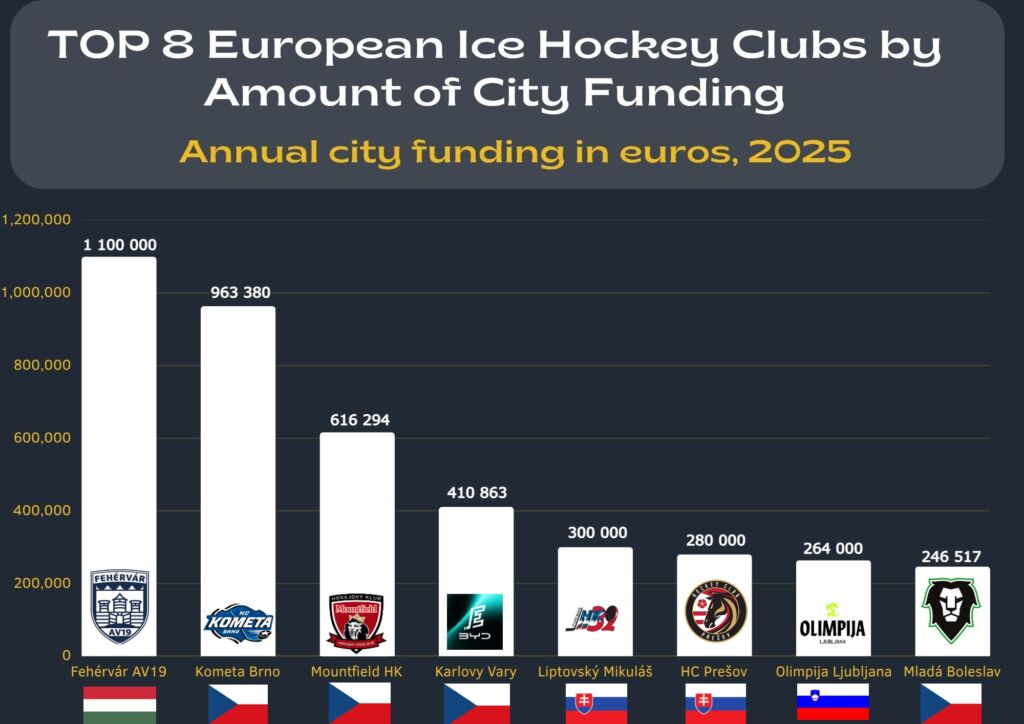
It lies 60 kilometers southwest of Budapest, has a population of 95,000 and is called Székesfehérvár. In 2025, the city provided the sports club Hydro Fehérvár AV19 with financial support of €1.1 million. Gábor Debreceni, the organization’s Finance Director, who has been involved in the international win2day ICE Hockey League (formerly EBEL) since 2007, offers his perspective on the figure: “I can imagine that we have the highest subsidy, but several things need to be taken into account:
1. Apart from this support, we receive no other support from the state.
2. We pay the city approximately €550,000 in rent for the MET Aréna (capacity: 6,000).
3. We operate a second arena in the city, the Gábor Ocskay Arena. Our youth teams train there, and the entire operation costs us approximately €800,000 per year. Editor’s note: In 2025, the city contributed €390,000 towards the operation of this arena.
4. We have the cheapest tickets in the league, averaging €8. We cannot compare ourselves with the other Austrian clubs in the league, where tickets and VIP tickets are much more expensive.”
In second place is the Czech Republic’s second-largest city. In 2025, Brno provided HC Kometa Brno with €963,380 in support. Kometa is also one of the few clubs in Europe that operates its own arena, which costs it more than €1.6 million annually. The situation will change from January 2027. The players and coaching staff will move to the new T-Mobile Arena, with a capacity of 12,300, while Winning Group Arena will become the club’s training center. Financing two arenas would be unsustainable for club owner Libor Zábranský in the long term. The club therefore asked the city for a subsidy to operate Winning Group Arena, which the city approved for 2026 in the amount of €758,000.
Three Czech top-flight clubs, in which the city is a significant shareholder, receive substantial support:
1. Mountfield HK. The City of Hradec Králové owns 50% of the club’s shares. In the 2024/25 season, the city contributed €616,294 to the A-team. In 2025, the club paid €209,000 for the use of the ice arena. Half of this amount, €104,500, was covered by the city contribution, while the other half was paid from the club’s own funds.
2. HC Energie Karlovy Vary. The City of Karlovy Vary owns a 40% stake in the club. In 2024, the city foundation contributed €410,863 to the club’s activities. In 2025, the organization paid an estimated €250,000 to rent the arena.
3. BK Mladá Boleslav. The City of Mladá Boleslav owns a 34% stake in the club. In 2025, the city contributed €246,517 to the A-team. The club can use the ice surfaces and facilities of the arena free of charge. The city spends nearly €1 million on the operation of the main and training ice surfaces.
Three clubs are also in a particularly favorable position, with the city’s financial contribution significantly exceeding the amount they pay in arena rent:
1. HK 32 Liptovský Mikuláš (Tipos Extraliga). In 2025, the club received a contribution of €300,000. It could use the arena free of charge, while its operation cost the city €430,000.
2. Olimpija Ljubljana (ICEHL). In 2025, the club received a contribution of €264,000. It had access to the arena’s facilities and equipment worth €283,803 and paid an additional €31,756 for other services.
3. Herlev Eagles (Metal Ligaen). In 2025, the club received a contribution of €173,910 and paid an additional €33,110 for arena rental.
Then there are clubs from two top European leagues where the city contribution falls far short of even covering the rent. Linköping HC received approximately €150,000 from the city, but paid €721,400 for its arena in 2025. Lausanne HC received a contribution of €164,300, while its arena costs are arguably even higher than those of its Swedish counterparts.
In 2025, 44 European cities provided professional hockey organizations with a total of €6.47 million in direct financial support. That amounts to an average of approximately €147,000 per club. A lot or a little?
